
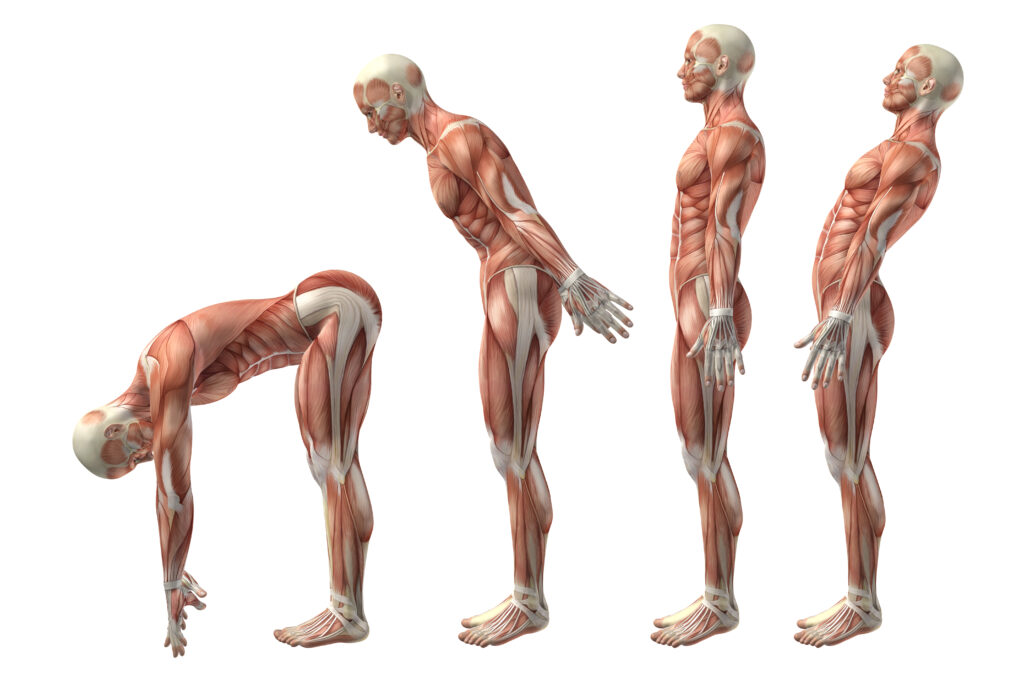
Build balanced strength, fix posture issues, and maximize your gym time with this underrated training split.
Introduction
If you’ve been doing Push/Pull/Legs for years and feel like you’re spinning your wheels, or if Upper/Lower splits leave you spending too much time in the gym, there’s a training approach you might have overlooked: the Anterior Posterior Split.
This split divides your training not by movement pattern or body region, but by the front (anterior) and back (posterior) of your body. It’s a method backed by anatomy, optimized for muscle balance, and surprisingly effective for lifters who want to train 4 days per week without compromise.
In this guide, you’ll learn:
- The science behind anterior and posterior muscle chains
- How A/P split compares to other popular splits
- A complete 4-day program with sets, reps, and rest times
- How to progress and avoid common mistakes
- Whether this split is right for your goals
What Are the Anterior and Posterior Chains?
Before we get into programming, you need to understand what we’re actually training.
The Anterior Chain (Front of Your Body)
Your anterior chain includes all the muscles on the front side of your body. These muscles are primarily responsible for:
- Pushing movements
- Flexion (bending joints)
- Forward motion
Anterior Chain Muscles:
| Muscle Group | Location | Primary Function |
|---|---|---|
| Quadriceps | Front of thighs | Knee extension, squatting |
| Hip Flexors | Front of hips | Lifting legs, hip flexion |
| Rectus Abdominis | Front of core | Trunk flexion, stability |
| Pectorals | Chest | Horizontal pushing |
| Anterior Deltoids | Front of shoulders | Overhead pressing, front raises |
| Biceps | Front of upper arms | Elbow flexion, curling |
Real-world applications: Getting up from a chair, climbing stairs, pushing a door open, throwing a punch.
The Posterior Chain (Back of Your Body)
Your posterior chain includes all the muscles on the back side of your body. Research shows that posterior chain muscles are recruited at higher levels during trunk extension exercises, making dedicated training essential. These muscles handle:
- Pulling movements
- Extension (straightening joints)
- Backward and upward motion
Posterior Chain Muscles:
| Muscle Group | Location | Primary Function |
|---|---|---|
| Hamstrings | Back of thighs | Knee flexion, hip extension |
| Glutes | Buttocks | Hip extension, power production |
| Erector Spinae | Along the spine | Spinal extension, posture |
| Latissimus Dorsi | Mid-back | Pulling, shoulder extension |
| Rear Deltoids | Back of shoulders | Horizontal pulling |
| Trapezius | Upper back/neck | Scapular movement, posture |
| Triceps | Back of upper arms | Elbow extension, pushing |
Real-world applications: Running, jumping, deadlifting, pulling yourself up, maintaining posture.
Why Train Them Separately?
Here’s the key insight: most people have imbalanced anterior and posterior chains.
Modern life — sitting at desks, looking at phones, driving — creates a pattern of:
- Tight, overactive anterior muscles (hip flexors, chest)
- Weak, underactive posterior muscles (glutes, upper back)
This leads to:
- Rounded shoulders
- Anterior pelvic tilt
- Lower back pain
- Reduced athletic performance
A 2024 study published in PubMed found that 8 weeks of posterior chain and core training was effective in reducing anterior pelvic tilt and improving vertical jump performance. By dedicating separate days to each chain, you can:
- Address imbalances directly
- Improve posture systematically
- Maximize training focus on each muscle group
- Optimize recovery — front and back don’t compete for resources
Anterior Posterior Split vs. Other Training Splits
How does A/P split stack up against the popular alternatives?
Comparison Table
| Factor | A/P Split | Push/Pull/Legs | Upper/Lower | Bro Split |
|---|---|---|---|---|
| Days per week | 4 | 6 | 4 | 5-6 |
| Frequency per muscle | 2x/week | 2x/week | 2x/week | 1x/week |
| Session length | 60-75 min | 45-60 min | 60-90 min | 60-90 min |
| Recovery time | Excellent | Good | Good | Poor |
| Best for | Intermediate+ | Advanced | All levels | Bodybuilding |
| Muscle balance focus | Excellent | Moderate | Moderate | Poor |
When to Choose A/P Split
Choose Anterior Posterior Split if:
- You can train 4 days per week consistently
- You want to fix posture issues or muscle imbalances
- You’re bored with Push/Pull/Legs and want something fresh
- You want balanced aesthetics (not just mirror muscles)
- You’re an intermediate lifter (1+ years of training)
Don’t choose A/P Split if:
- You’re a complete beginner (start with beginner workout plans)
- You can only train 2-3 days per week
- You’re training for powerlifting competition (use sport-specific programming)
- You prefer very short workouts (PPL might suit you better)
The Complete 4-Day A/P Split Program
Here’s a battle-tested program you can start this week. The foundation is built on the big three compound lifts — squat, bench press, and deadlift — that have been the cornerstone of strength programs for decades.
Weekly Structure
| Monday | Anterior (Strength Focus) |
| Tuesday | Posterior (Strength Focus) |
| Wednesday | REST or Light Cardio |
| Thursday | Anterior (Hypertrophy Focus) |
| Friday | Posterior (Hypertrophy Focus) |
| Saturday-Sunday | REST |
Day 1: Anterior — Strength Focus
| Exercise | Sets | Reps | Rest | Notes |
|---|---|---|---|---|
| Back Squat | 4 | 5 | 3 min | Work up to heavy set |
| Barbell Bench Press | 4 | 5 | 3 min | Controlled descent |
| Overhead Press | 3 | 6 | 2.5 min | Strict form, no leg drive |
| Leg Extension | 3 | 10 | 90 sec | Squeeze at top |
| Incline Dumbbell Press | 3 | 8 | 90 sec | Upper chest focus |
| Barbell Curl | 3 | 8 | 90 sec | No swinging |
Total time: ~65 minutes
Day 2: Posterior — Strength Focus
| Exercise | Sets | Reps | Rest | Notes |
|---|---|---|---|---|
| Conventional Deadlift | 4 | 5 | 3 min | Reset each rep |
| Barbell Row | 4 | 5 | 3 min | Pull to lower chest |
| Weighted Pull-Up | 3 | 6 | 2.5 min | Add weight when possible |
| Romanian Deadlift | 3 | 8 | 2 min | Feel the hamstring stretch |
| Face Pull | 3 | 15 | 60 sec | Light, controlled |
| Tricep Pushdown | 3 | 10 | 60 sec | Lock elbows in place |
Total time: ~65 minutes
Day 3: REST
Options:
- Complete rest
- 20-30 minutes light walking
- Mobility/stretching routine
- Foam rolling
Day 4: Anterior — Hypertrophy Focus
| Exercise | Sets | Reps | Rest | Notes |
|---|---|---|---|---|
| Leg Press | 4 | 10 | 2 min | Feet shoulder-width |
| Dumbbell Bench Press | 4 | 10 | 90 sec | Full range of motion |
| Arnold Press | 3 | 12 | 90 sec | Rotation adds front delt work |
| Hack Squat or Sissy Squat | 3 | 12 | 90 sec | Quad isolation |
| Cable Fly | 3 | 15 | 60 sec | Constant tension |
| Incline Dumbbell Curl | 3 | 12 | 60 sec | Full stretch at bottom |
| Hanging Leg Raise | 3 | 12 | 60 sec | Control the movement |
Total time: ~60 minutes
Day 5: Posterior — Hypertrophy Focus
| Exercise | Sets | Reps | Rest | Notes |
|---|---|---|---|---|
| Romanian Deadlift | 4 | 10 | 2 min | Hip hinge, soft knees |
| Seated Cable Row | 4 | 10 | 90 sec | Squeeze shoulder blades |
| Lat Pulldown | 3 | 12 | 90 sec | Lean back slightly |
| Hip Thrust | 3 | 12 | 90 sec | Pause at top |
| Lying Leg Curl | 3 | 12 | 60 sec | Slow negative |
| Reverse Fly | 3 | 15 | 60 sec | Rear delt isolation |
| Overhead Tricep Extension | 3 | 12 | 60 sec | Full stretch |
| Back Extension | 2 | 15 | 60 sec | Bodyweight, controlled |
Total time: ~65 minutes
Progressive Overload: How to Keep Making Gains
The program above is just a starting point. To keep progressing, you need progressive overload — gradually increasing the demands on your muscles over time.
When to Increase Weight
Increase the load when you can complete all prescribed reps with good form for two consecutive sessions.
How Much to Add
| Movement Type | Weight Increase |
|---|---|
| Upper body compounds | 2.5-5 lbs (1-2.5 kg) |
| Lower body compounds | 5-10 lbs (2.5-5 kg) |
| Isolation exercises | 2.5 lbs or add 1-2 reps |
The Importance of Tracking
Here’s the truth: if you’re not tracking, you’re guessing.
You need to know what you lifted last week to know if you’re progressing this week. Whether you use a notebook, spreadsheet, or workout app, record every session.
Pro tip: I log every workout in Jefit — it tracks my weights automatically and shows me when I’m ready to progress. The muscle recovery feature also helps me see which areas need more rest before hitting them again.
Recovery: The Other Half of the Equation
Training breaks your muscles down. Recovery builds them back stronger. A systematic review and meta-analysis found that 12-16 weeks of posterior chain resistance training significantly improved pain, disability, and muscle strength in patients — demonstrating the importance of proper training and recovery protocols.
Muscle Recovery Times
| Muscle Group | Recovery Time |
|---|---|
| Small (Biceps, Triceps, Rear Delts) | 24-48 hours |
| Medium (Chest, Lats, Front Delts) | 48-72 hours |
| Large (Quads, Hamstrings, Glutes) | 72-96 hours |
Recovery Checklist
Sleep:
- Aim for 7-9 hours per night
- Consistent sleep schedule
- Dark, cool room
Nutrition:
- Protein: 0.8-1g per pound of bodyweight
- Calories: Slight surplus for muscle gain, slight deficit for fat loss
- Hydration: At least 0.5oz per pound of bodyweight
Common Mistakes (And How to Avoid Them)
Mistake #1: Wrong Exercise Classification
The problem: Putting posterior exercises on anterior day (or vice versa).
The fix: Classify by muscle location, not movement pattern. If it trains the front → Anterior day. If it trains the back → Posterior day.
Mistake #2: Neglecting the Posterior Chain
The problem: Going hard on anterior day and phoning in posterior day.
The fix: Track your lifts. Your deadlift and row should progress at similar rates to your squat and bench.
Mistake #3: Not Tracking Progress
The problem: Walking into the gym without knowing what you lifted last week.
The fix: Log every workout. Write it down, use a spreadsheet, or use a workout tracking app.
Mistake #4: Skipping Rest Days
The problem: Training 5-6 days instead of 4.
The fix: Trust the process. Rest days are when you actually grow.
Frequently Asked Questions
Can I train 3 days per week instead of 4?
Yes, but you’ll need to rotate: Week 1: A → P → A, Week 2: P → A → P.
Where does core training fit in?
Add 2-3 core exercises at the end of Anterior days. Your abs are part of the anterior chain.
What about cardio?
Rest days: 20-30 minutes low-intensity. Or after lifting: 10-15 minutes moderate intensity.
Can beginners do this split?
Not recommended. Start with Full Body (3x/week) for 0-6 months, then Upper/Lower for months 6-12. After 12+ months, try A/P split. Check out our beginner workout plans if you’re just starting out.
How long should I run this program?
Run it for 8-12 weeks, then reassess. If progress stalls, take a deload week or try a different split.
Conclusion
The Anterior Posterior Split isn’t for everyone — but for the right lifter, it’s a game-changer.
Choose this split if you:
- Train 4 days per week consistently
- Want to fix muscle imbalances or posture
- Have at least one year of lifting experience
- Want a fresh approach that prioritizes balanced development
The key to success:
- Follow the program as written
- Track every workout
- Progress gradually
- Prioritize recovery
- Stay consistent for at least 8-12 weeks
Discipline isn’t something you’re born with — it’s something you build. And it’s built one workout at a time.
Ready to Start?
Download Jefit to save this routine, track your weights, and monitor your muscle recovery. With 1,400+ exercises in the database, you can customize the program to fit your equipment and preferences.
Your anterior and posterior chains are waiting. Time to train them right.

- A Simple Guide to Progressive Overload Training (With Examples) - June 9, 2026
- Best Workout Planner App in 2026 for Weight Training - June 3, 2026
- Best Workout Apps 2026: Top Options Tested and Reviewed - May 20, 2026